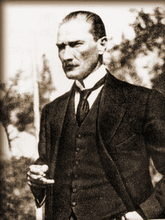
A friendly visitor (thank you! teşekkür ederim!) commented on one of my blog entries, referencing this site as another online resource to check out. After a short review, I like what I see enough to add it to my blog's favorite links (look to your left under the picture of Turkey's flag.
Scroll down the home page to learn a little about Manisa.
Sunday, July 27, 2008


Saturday, June 14, 2008
The importance of independent thought
Andrew Mango's exhaustive review of the events leading to the establishment of modern Turkey makes clear why its capital ended up in Ankara, far from Istanbul. In the post World War I era, it was hard (poor roads) and dangerous (bandits) to get to. Istanbul was occupied by the Allies.
With hundreds of years of Ottoman roots planted in Istanbul, it's understandable why Atatürk would want to make some other city the new seat of government even after independence was one. It was an effective way of marking the start of a new era.
Speaking of independence, Atatürk said in a speech in Ankara 1920 "that while one had to work form the roots upwards to build a solid organization, at the start one had no choice but to work from the top downwards, since until individuals had learnt to think for themselves, masses could be manipulated."
Quite true.
With hundreds of years of Ottoman roots planted in Istanbul, it's understandable why Atatürk would want to make some other city the new seat of government even after independence was one. It was an effective way of marking the start of a new era.
Speaking of independence, Atatürk said in a speech in Ankara 1920 "that while one had to work form the roots upwards to build a solid organization, at the start one had no choice but to work from the top downwards, since until individuals had learnt to think for themselves, masses could be manipulated."
Quite true.
Tuesday, June 10, 2008
A National Secret
I'm taking a break from the tedious work of tiling a closet. Technically, this kind of tiling—peel and stick—is easy. However...the closet is not a perfect square or rectangle. Plus, the threshold from the living room threw off my line of attack, forcing an additional set of cut tiles to fit neatly along the wall. Then there was the chore of cutting pieces to fit around a hot water tank.
All that in a tight, cramped space. It made me feel better about the good money I paid professionals to tile my kitchen and bathroom. Well worth it!
Anyway, on to my topic tonight.
Andrew Bey reports...
All that in a tight, cramped space. It made me feel better about the good money I paid professionals to tile my kitchen and bathroom. Well worth it!
Anyway, on to my topic tonight.
Andrew Bey reports...
Mustafa Kemal said in 1927 that it was immediately clear to him that the monarchy would be the relentless enemy of the national will. But to spell out the...inevitability of a republic...would frighten people who found the prospect contrary to their traditions, their mental capacity and their mentality. In order to preserve unity in the struggle for independence, Mustafa Kemal was obliged to keep to himself as 'a national secret the great capacity for development which I discerned in the nation's conscience and future.'The philosopher-king idea and its problems come to mind. The report continues...
In a conversation which occupied the night of 7/8 July (1919), Mustafa Kema is said to have allowed Mazah Müfit to note down five long-term objectives:Personally, I appreciate the last item. At the same time, I look forward to learning about what must have been a tumultuous period while the nation's language was changed!
- the proclamation of a republic
- 'appropriate treament' of the dynasty
- abolition of Islamic dress for women
- and a ban on wearing of the fez by men,
- and the introduction of the Latin alphabet
Monday, June 9, 2008
Mobilizing Resistance
In 1919, Mustafa Kemal faced a number of obstacles to building resistance. At the same time, he also had some opportune factors. Andrew Bey reports...
Now, that's on the tiny scale of my particular career experience. When I pause to think about it on the historic scale of Mustafa Kemal's effort for Turkey, I am in awe.
The army had a cadre of patriotic officers ready to defend the country. But although they were united by a common ideal, they were divided by personal and professional jealousies. The forces at their disposal were woefully weak and ill-equipped. What is more, officers were conditioned to obey orders, ultimately from Istanbul. Fortunately, the general staff was sympathetic to the national cause. Fortunately also, the best officers had developed a spirit of initiative, first in the revolutionary struggle against Abdülhamit and then in foreign wars. The civil service too did not lack patriotic officials, but initiative had been sapped out of them. To survive, they had to lie low and do as they were told.There is much more to the report, of course. I highlight this passage because the part about initiative being sapped out of a group of people, of lying low and doing as they're told echoes what I see too often in the modern American workplace. It takes a special effort to maintain a spirit of initiative, to stand up to the forces that seek to stifle that spirit. It's difficult but well worth the effort.
Now, that's on the tiny scale of my particular career experience. When I pause to think about it on the historic scale of Mustafa Kemal's effort for Turkey, I am in awe.
Wednesday, May 14, 2008
Bulgarian Transformation (circa 1913)
At the time of Mustafa Kemal's arrival in Sofia, the Bulgarians "had been generally regarded as among the most backward of the sultan's subjects." [page 130 of Mango's biography] Yet something happened to transform them, which "amazed the Turks". Mango reports that this transformation has been attributed to the work of "'popular enlighteners'—nationalist teachers who imparted new learning as they went out to the people in the spirit of the Russian narodniks (populists)."
Mango reports that the Bulgarian transformation made a deep impression on Mustafa Kemal, "who was later to adopt populism (halkçılık) as one of the six basic principles of the Turkish republic."
I'm not familiar with populism as an explicit idea. The Wikipedia link defines it as "a discourse which supports 'the people' versus 'the elites'." In the post-serf era in which the Narodniks were born, that definition is understandable. How exactly does that term applies to the Turkish context? I look forward to learning.
In the meantime, what's important here is the impression his Sofia experience made on him and its eventual impact on Turkey.
Mango reports that the Bulgarian transformation made a deep impression on Mustafa Kemal, "who was later to adopt populism (halkçılık) as one of the six basic principles of the Turkish republic."
I'm not familiar with populism as an explicit idea. The Wikipedia link defines it as "a discourse which supports 'the people' versus 'the elites'." In the post-serf era in which the Narodniks were born, that definition is understandable. How exactly does that term applies to the Turkish context? I look forward to learning.
In the meantime, what's important here is the impression his Sofia experience made on him and its eventual impact on Turkey.
Monday, May 12, 2008
Gökalp
Occasionally, Mustafa Kemal listened, and to no one more carefully than to Ziya (Gökalp), an intellectual born in Diyarbakır, in the Kurdish area.... Like many of his contemporaries, Gökalp was strongly influenced by French writers, in his case particularly by the sociologist Emile Durkheim (1858-1917), from whom he derived his notion of religion as social cement. Religion, Gökalp believed, inspired culture, which was specific to individual national societies, while civilization, meaning primarily science and technology, was universal. Like other members of the CUP, Gökalp started by defending the concept of a common Ottoman patriotism. But, before long, he became the chief ideologist of a Western-oriented Turkish nationalism, based not on ethnic origin, but on common culture and language.... Mustafa Kemal learnt from him 'the ideals of nationalism and of populism, which were to inform the republic of Turkey...'.[page 95/96 of Andrew Mango's biography]Continuing his report of the "intellectual ferment" (and how!) of this period, Mr. Mango reports: "An influential literary review, Genç Kalemler (Young Pens), campaigned for a simpler Turkish language, relying more on its own vocabulary than on borrowings from Arabic and Persian. It was in Genç Kalemler that Ziya Gökalp published his celebrated poetic manifesto of Pan-Turanianism, the romantic ideology which sought the union of all Turkic-speaking peoples:
The country of the Turks is not Turkey, nor yet Turkistan,Fascinating.
Their country is a vast and eternal land: Turan!
Friday, May 9, 2008
Ali Fuat on the French Revolution
Mr. Mango reports (on pages 48-49) that Ali Fuat wrote the following about the feelings of the cadets in Atatürk's class in military high school:
This information was news to me. Fascinating.
At the same, it's not too surprising given Mr. Mango's report in his introduction on page 6: "The Ottoman's connection with the French was old. It went back to the alliance concluded in 1541 between Sultan Süleyman I (Suleiman the Magnificient) and Francis I of France against the Habsburg emperor Charles V."
My appreciation of Mr. Mango's work increases with each page I read. It's expanding my knowledge of an important part of world history. I welcome learning more about Atatürk and, in effect, about modern Turkish history.
Sultan Adülhamit II, in whose honour we had to shout 'Long live our Padishah' several times a day, gradually lost lustre in our eyes. We were indignant at the treatment of young enlightened supporters of freedom in the medical school who were sent into exile and whose careers were ruined. One day we might meet the same fate. As we heard that the government worked badly, that corruption was rife, that civil servants and officers did not receive their pay, while secret policemen and courtiers, covered in gold braid, received not only their pay but purses full of gold, our confidence in the sultan, which was not strong at the best of times, was totally shaken. We saw that delivered into incompetent hands, the army was losing its effectiveness and prestige...But no one dared ask 'Where are we going? Where are you taking the country?' Afraid of the sultan and his secret policemen, people were plunged in abject oriental resignation...There was no freedom in the country. As young students in the War College, we had read in secret and learnt the importance given to human rights and freedoms in the declarations of the French Revolution.Mr. Mango reports that Alex Jevakhoff, Atatürk's French biographer, that the French Revolution and its Declaration of Human Rights "was to be 'the supreme point of reference' throughout his life."
This information was news to me. Fascinating.
At the same, it's not too surprising given Mr. Mango's report in his introduction on page 6: "The Ottoman's connection with the French was old. It went back to the alliance concluded in 1541 between Sultan Süleyman I (Suleiman the Magnificient) and Francis I of France against the Habsburg emperor Charles V."
My appreciation of Mr. Mango's work increases with each page I read. It's expanding my knowledge of an important part of world history. I welcome learning more about Atatürk and, in effect, about modern Turkish history.
Subscribe to:
Posts (Atom)