Friday, May 9, 2008

Turkish: Then and Now

Mr. Mango reports on page 41 ("The Making of an Ottoman Officer"):
...It was thus at the school in Manastır that Atatürk began acquiring his mastery of literary Ottoman, a euphonious and euphuistic idiom, where Arabic abstract nouns crowd together in alliterative groups of synonyms to raise the emotional tone rather than to clarify the meaning.
Good epistemological food for thought. I've filed it away for future reference.

Mr. Mango's report continues:
Atatürk became an effective writer and speaker of this artificial tongue, which served him well in his public appearances. Unfortunately, it is now incomprehensible in its original form to Turkish readers, for whom translations into simple Turkish have to be provided.
This I had heard during my studies of Turkish. Ironic.

Thursday, May 8, 2008

7 April 1913

Mr. Mango reports:
On 7 April 1913, Ahmet Izzet Paşa informed the Composite Force in Gallipoli that Muslim clergy were to be sent to raise the morale of the troops [following the fall of Edirne]. Mustafa Kemal sent a curt reply the following day, saying his brother officers and regimental chaplain were giving the troops all the advice that was necessary and that the despatch of extra preachers would serve only to propagate the view that the soldiers were demoralized, and that the authorities were reduced to prayerful supplications.
Impressive.

Tuesday, May 6, 2008

Printing Press Delay

Andrew Bey writes (page 5; introduction)
...It was not until 1727 that a Hungarian from Transylvania, who had converted from Unitarianism to Islam, was able to set up in Istanbul a first printing press using Arabic characters. It was closed down after a few years, and printing had to be reintroduced later.
Interesting.

Rulers vs unbelievers

In Mr. Mango's (Andrew Bey) introduction to his biography of Atatürk, he writes (on page 5)
Since [the Ottoman rulers] possessed revealed truth which had shown its worth during the expansion of Ottoman power, they were reluctant to turn to unbelievers for anything other than technical advice. When they did so, they had to disguise their purpose. In any case, the official ideology of the state was an obstacle to innovation.
This report fascinates me. In substance, it echoes the same experience many have in modern American business. That is, many managers and executives conduct themselves as if they possess revealed truth. Most who report to them are deemed, in effect, unbelievers to whom they turn only for technical advice. Though, in this case, their purpose is not disguised. What is often covered up or glossed over is the significance of the immense dedication needed to acquire and develop the specialized knowledge that produces competent technical advice. In any event, the unofficial ideology of the current state of common American management is an obstacle to innovation.

Sunday, May 4, 2008

Atatürk biography

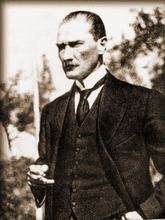
In a Sante Fe, New Mexico bookstore, I found a copy of the biography of Atatürk by Andrew Mango. It's excellent. It's rich with details of the context in which Atatürk (and, in effect, modern Turkey) was born. As if I didn't already have enough motivation to learn Turkish, this fine biography has added fuel to the fire.

Michael Doran, Washington Post Book World, writes that Mango's biography is "the best in the English language." I can't judge that for myself since it's the only biography I've seen so far of Atatürk. Though I'm only 106 pages into it, I can say that's it comprehensive, even going into the Enlightenment era French philosophy that influenced Atatürk and his contemporaries.

As my schedule permits, I'll be posting some excerpts from the book.

Thursday, April 17, 2008

Consonant harmony!

Something interesting I came across follows. First, some context.

David and Asuman Pollard's wonderful textbook Teach Yourself Turkish shows how Turkish handles to, at, and from as follows:
  • -de indicates there's no movement to or from
  • -e indicates there's movement towards
  • -den indicates there's movement away from
The example provided is simple:

EnglishTurkish
houseev
at the houseevde
to the houseeve
from the houseevden

Now, here's the interesting part (or what I call a curveball): a d can become a t! The Pollards explain it as follows:
Question: What do the words maç, dolap, beş, sokak, and raf have in common? Answer: They all end in a 'whispery' (unvoiced) consonant. The d in the ending becomes t in order to be whispery too. This is similar to vowel harmony, but with consonants!
Consonant harmony!? Very cool. Çok serin.

Apart from that interesting and logical twist, it also helps me feel less bewildered when I see words that don't show up in Turkish dictionaries and which I can't parse with the other rules I've learned so far.

Again, very cool. Tekrar, çok serin.

Sunday, April 6, 2008

www.ataturk.com

This site showed up on my radar today. I found it interesting enough to add to my favorite links off to the side of this page.